Efficient water management is one of the most important factors in modern farming. Whether water is being transported from a borewell to a field, distributed through an irrigation network, or supplied to different sections of a farm, a dependable piping system helps ensure that water reaches where it is needed. This is where agriculture pipes and fittings play an important role. Designed for agricultural water transportation and irrigation applications, these systems can help farmers and irrigation professionals develop organised, practical, and durable water-supply networks.
What Are Agriculture Pipes and Fittings?
Agriculture pipes are piping products used to transport water across farms and agricultural properties. They can form the main pipeline between a water source and an irrigation area or serve as distribution lines within a larger irrigation system.
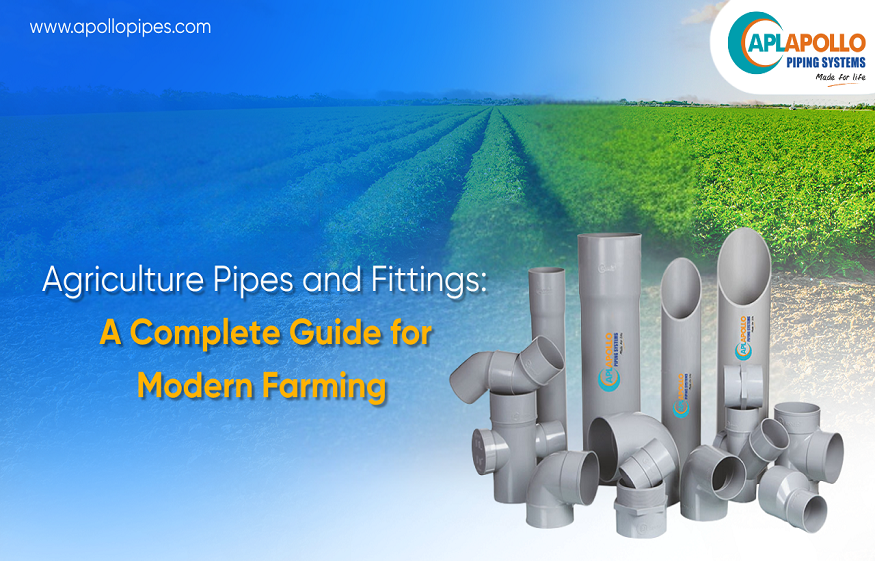
Agriculture pipe fittings complement the pipes by connecting sections, changing the direction of flow, closing pipeline ends, reducing or adapting connections, and creating branches. Depending on the system design, fittings may include couplers, reducers, end caps, adaptors, tees, bends, and other connection components.
Together, agriculture pipes and fittings can be used for farm irrigation, underground pipelines, tube wells, borewells, and agricultural water-supply networks. Choosing compatible pipes and fittings is important for developing a properly connected irrigation piping system.
Why Are Agriculture Pipes Important for Modern Farming?
Modern farming increasingly focuses on using water efficiently while keeping irrigation infrastructure practical and manageable. Agriculture pipes offer several benefits that make them suitable for different agricultural applications.
l Efficient Water Transportation
A properly designed pipeline can transport water from a source to the required areas of a farm through dedicated supply and distribution lines. This makes piping an important part of organised agricultural water management.
l Easy Handling and Installation
Many modern plastic agriculture pipes are comparatively convenient to handle and install. Their practical installation characteristics can be particularly useful when developing or modifying irrigation networks.
l Durability and Long Service Life
Agricultural pipelines may be exposed to outdoor conditions, soil, moisture, and regular water flow. Selecting a suitable material and properly installing the system can support reliable service over an extended period.
Read More: Lead The Way – The Importance of Internal Signage
l Resistance to Corrosion and Chemicals
PVC and other plastic piping materials are valued for their resistance to corrosion. This can make them suitable for applications where conventional metallic pipes may require greater protection against rust or chemical exposure.
l Secure Connections and Lower Maintenance
Compatible fittings and appropriate jointing methods help create secure connections throughout an irrigation network. Properly designed joints can reduce the possibility of leakage and help keep maintenance requirements manageable.
Types of Agriculture Pipes and Fittings
Different agricultural projects require different piping arrangements. PVC agriculture pipes and their compatible fittings are widely used for water transportation and irrigation. They can be selected in different diameters and pressure classes according to system requirements.
HDPE pipes are another related solution, particularly for applications requiring flexible pipeline arrangements. Sprinkler irrigation systems may also use specialised components such as risers, adaptors, nozzles, couplers, reducers, and end caps.
The appropriate choice depends on the water source, required flow, irrigation method, installation conditions, and overall system design.
How to Choose the Right Agriculture Pipes and Fittings
Before purchasing agriculture pipes and fittings, farmers and irrigation contractors should evaluate several factors:
- Pipe diameter: Select a suitable diameter based on the required water flow and pipeline design.
- Water pressure: Consider the operating pressure and appropriate pressure class for the application.
- Irrigation method: Drip, sprinkler, surface, and other irrigation arrangements may have different piping requirements.
- Pipe material: PVC/uPVC, HDPE, and other materials have different characteristics and applications.
- Fittings and joints: Ensure that fittings are compatible with the selected pipe and jointing method.
- Installation conditions: Consider whether the pipeline will be installed above ground, underground, or in another environment.
- Durability and maintenance: Look for products suited to the expected operating conditions and maintenance requirements.
- Quality standards: Products manufactured according to applicable standards can provide an important benchmark when selecting agricultural piping solutions.
A properly planned system should consider the entire network rather than choosing pipes based only on diameter or price.
Applications of Agriculture Pipes and Fittings
The versatility of modern agricultural irrigation pipes makes them useful across a wide range of applications. Common uses include:
- Farm irrigation systems
- Agricultural water-supply lines
- Underground water pipelines
- Tube wells and borewells
- Sprinkler irrigation systems
- Water distribution across agricultural fields
- Connections between water sources, pumps, and irrigation networks
The right combination of pipes, fittings, valves, and irrigation components can help create an organised water distribution system suited to the specific requirements of a farm.
Read More: Lawn Maintenance Service: What Your Lawn Needs in April for Healthy Growth
APL Apollo Agriculture Pipes and Fittings
APL Apollo’s uPVC agriculture piping system is designed for water supply and irrigation applications and is available in different sizes and pressure classes. According to APL Apollo’s official product information, its agriculture pressure pipes are manufactured as per IS 4985:2000, with sizes ranging from 20 mm to 400 mm, while pressure fittings conforming to IS 7834 are available from 40 mm to 225 mm. The company highlights features including the use of quality raw materials, easy handling, transportation and installation, chemical resistance, non-conductive properties, longevity, stringent quality standards, and leak-proof joints. The system is intended for applications including agricultural farms, domestic water-supply lines, agricultural and domestic tube wells, and borewells. APL Apollo also lists an HDPE sprinkler-system range with related components such as couplers, end caps, bends, tees, sprinkler adaptors, riser pipes, nozzles, and reducers.
Overall, selecting the right agriculture pipes and fittings is an important step towards building a practical and dependable irrigation infrastructure. Farmers and agricultural professionals should consider application, flow requirements, pressure, material, installation conditions, compatibility, and applicable standards before making a choice. A well-planned irrigation piping system can provide a structured foundation for efficient agricultural water distribution and support the changing needs of modern farming.